
产品
How Does Accomy Work? A Guide for Travel Teams
Accomy unifies flights, hotels, policy caps, payment, and human support in one travel operating system, paid through a booking markup included in the final price, with no subscription.
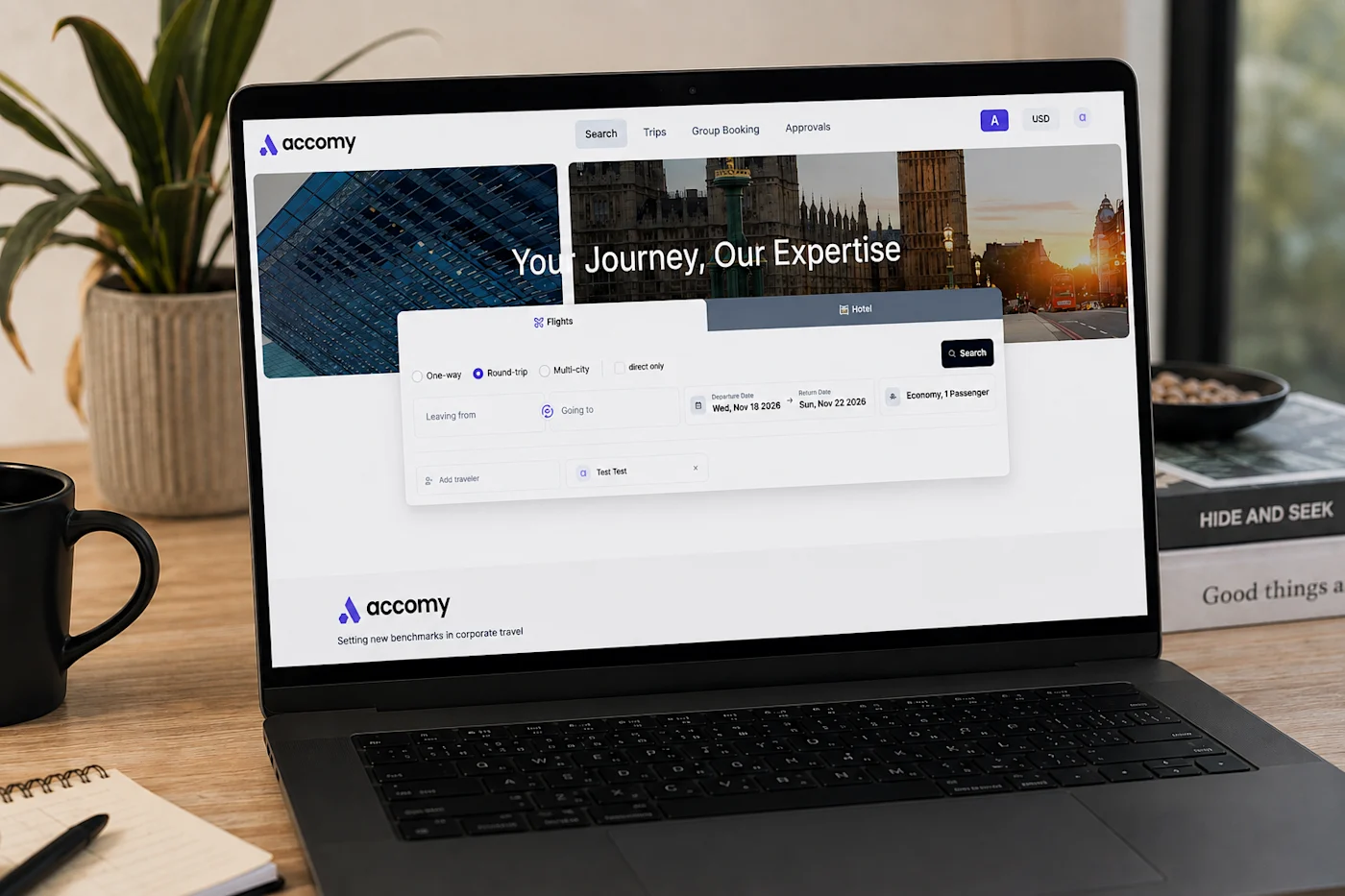
How Does Accomy Work? A Guide for Travel Teams
Accomy is a travel operating system: one place to book flights and hotels, keep them inside policy, pay and reconcile, and reach a human when a trip goes sideways. It replaces the tangle of a booking site, a card statement, and an inbox full of exceptions, with a single system a finance team can actually audit. In the SME programmes we work with, the problem is rarely a missing tool; it's that booking, policy, payment, and reporting sit in four places that never talk to each other, and closing that gap is the whole point.
This guide explains, plainly, how it works day to day: what's live now, what it costs, how travel agencies use it, and what's still being built. It's written for travel managers, finance leads, and agency owners weighing whether Accomy fits how they already work.
Key Takeaways
• Accomy unifies flight and hotel booking, policy caps, payment, and human support in one platform: GDS- and NDC-powered, with hotel savings of 10–40% per trip versus direct consumer booking.
• It earns a booking markup that's already included in the final price, with no subscription fee, set against the record $1.57 trillion companies spent on business travel in 2025 (GBTA, 2025).
• Its edge for APAC teams is concrete: local inventory, multi-currency payment via Airwallex, and human support on WhatsApp, Line, and WeChat.
• Travel agencies use Accomy's online booking tool to book flights and hotels for their own clients.
What is Accomy, exactly?
Accomy is a corporate travel platform that brings booking, policy, payment, and support into one operating system, not a booking site bolted onto a spreadsheet. The framing matters because the alternative is expensive: in 2025, 43% of employees said they frequently or occasionally paid out of pocket to book outside policy, rising to 50% among travel buyers themselves (GBTA, Business Travel Outlook Poll, October 2025). Fragmented tools are how that leakage hides.
One log-in covers the jobs that usually need four: search and book flights, search and book hotels at negotiated rates, apply spend caps, and reconcile the payment. The point isn't more features. It's fewer places for spend to go dark.
The category word is deliberate: an operating system is infrastructure a company runs on, not another tab to check.
How does booking a trip actually work?
A booker searches, books, and pays inside Accomy: the same flow as a consumer site, but with corporate rates and controls attached. Flights run on GDS content with NDC integration for full fare access, including corporate fare agreements and loyalty support; hotels draw on GDS inventory, direct hotel contracts, and OTAs, with savings of 10–40% per trip versus direct consumer booking (Accomy product reference, 2026).
Day to day, it looks like this:
Search flights or hotels, seeing the negotiated corporate rates your company has, not just public fares.
Book within the price cap set for the traveller's grade, the platform enforces the cap at booking time.
Pay through the integrated Airwallex layer, in the right currency, on a corporate card.
Get help from a human concierge when a booking needs changing or a trip is disrupted.
Booking is the easy part of any tool. Doing it inside the rate and the rule is what makes it a programme rather than a shopping trip.

How does Accomy keep travel within policy and budget?
Control comes from three things that are live today: price caps by employee grade, negotiated rates that are actually loaded into the booking flow, and multi-currency payment that reconciles as you go. Flight and hotel caps are enforced at the point of booking, so an out-of-policy trip is caught before it happens, not at month-end close. Payment and reconciliation run through Airwallex, a genuine advantage for APAC companies juggling several currencies across markets.
Where a company lacks procurement muscle, Accomy's managed RFP service sources and loads fixed hotel rates on its behalf, from hotel education through negotiation to rate loading.
Honest note: deeper policy controls (approval workflows, advance-booking rules, preferred-airline logic) are on the roadmap, not live today. What's live is grade-based caps, loaded rates, and Airwallex reconciliation. We'd rather you know that before a demo than after.
Budgets don't hold because a policy document exists. They hold because the compliant choice is the one already loaded at booking.
What makes Accomy different for APAC teams?
Accomy is built APAC-first, which shows up in inventory, payment, and support rather than in a slogan. Its hotel coverage is strongest across China routes and major APAC cities; payment is multi-currency by default; and human support runs on the channels the region actually uses: WhatsApp, Line, WeChat, web chat, email, and phone. That matters when 2026 corporate hotel rates are climbing fastest in APAC gateways: Bengaluru is forecast up 6.4%, Hyderabad 5.7%, and Mumbai 5.3% year on year (Amex GBT, Hotel Monitor 2026, via Business Travel News, 2025).
Here's how that lands against the two options most teams already know:
Legacy TMC | DIY (OTA + spreadsheet) | Accomy | |
Setup | Slow, enterprise-scale minimums | Instant, but no controls | Built for teams that have outgrown DIY |
Negotiated rates | Yes, opaque | No | Yes, loaded into booking |
Policy caps at booking | Sometimes | No | Live (by grade) |
Multi-currency pay + reconcile | Add-on | Manual | Live (Airwallex) |
APAC support channels | Limited | None | WhatsApp, Line, WeChat, web, phone |
The honest trade-off: Accomy's UX isn't as polished as the best-funded competitors yet. What it offers instead is a human service layer, APAC-native inventory, and pricing that works for a 50-person company: not just a 5,000-person one.
How much does Accomy cost?
Accomy charges a booking markup that's already included in the final price, with no subscription fee and no hidden service charges (Accomy pricing model, 2026). You pay when you book, not to hold a licence. For a founder or finance lead, the number to weigh it against isn't zero; it's what unmanaged travel already leaks through overspend and admin time, against a global business-travel market that hit a record $1.57 trillion in 2025 and is forecast to grow 8.1% in 2026 (GBTA, 2025).
One caveat worth stating plainly: if you benchmark a single fare against Google Flights, you'll sometimes find a cheaper one-off booking. That's not the value: consolidation, visibility, and policy are.
The pricing is designed to be legible: no subscription to justify, no per-seat maths, just a small markup on trips you were taking anyway.
How do travel agencies use Accomy?
Travel agencies use Accomy's online booking tool (OBT) to book flights and hotels for their own clients: the same GDS and NDC content and negotiated rates, without building the booking rails themselves. White-label capability is available for agency and enterprise clients, so the experience can carry the agency's brand.
For a small or growing agency, the appeal is practical: access to aggregated inventory and corporate rates, multi-currency payment, and a support layer, without a direct GDS subscription and the overhead that comes with it.
The corporate buyer and the agency use the same engine: one books for their company, the other books for their clients.
What's live today, and what's coming next?
Most of the core is live: flight and hotel booking on GDS/NDC, grade-based price caps, Airwallex payment and reconciliation, managed RFP rate sourcing, and human concierge support. Being straight about the rest builds more trust than a feature list that outruns the product.
On the roadmap over the next 6–12 months: an AI booking assistant with smarter policy enforcement, deeper expense and ERP integration (Xero, QuickBooks, SAP and similar), and expanded inventory such as trains and travel insurance. These are in development, not shipping today.
If a feature isn't live, we say so, because the gap between a brand promise and a first login is where trust is won or lost.
Frequently Asked Questions
What is Accomy in one sentence?
Accomy is a travel operating system for companies: one platform to book flights and hotels at corporate rates, enforce spend caps, pay and reconcile in multiple currencies, and reach human support. It's GDS- and NDC-powered, with hotel savings of 10–40% per trip versus direct consumer booking (Accomy product reference, 2026).
How much does Accomy cost?
Accomy charges a booking markup that's already included in the final price, with no subscription fee and no hidden service charges (Accomy pricing model, 2026). You pay only when you book. The comparison that matters is against unmanaged overspend and admin time, not against zero, global business travel spend hit a record $1.57 trillion in 2025 (GBTA, 2025).
Does Accomy work well for APAC companies?
Yes. It's built APAC-first. Hotel coverage is strongest across China and major APAC cities, payment is multi-currency via Airwallex, and support runs on WhatsApp, Line, and WeChat. This matters as APAC corporate hotel rates rise fastest in 2026, led by Indian gateways such as Bengaluru at +6.4% (Amex GBT, via Business Travel News, 2025).
Can travel agencies use Accomy?
Yes. Agencies use Accomy's online booking tool to book flights and hotels for their own clients, with GDS/NDC content and negotiated rates, and white-label options to carry the agency's brand. It gives a smaller agency access to aggregated inventory without a direct GDS subscription.
What does Accomy not do yet?
Approval workflows, advance-booking rules, preferred-airline logic, deeper expense/ERP integration, an AI booking assistant, and expanded inventory (trains, insurance) are on the roadmap, not live today. What's live is booking, grade-based price caps, Airwallex payment and reconciliation, and managed RFP rate sourcing.
How is Accomy different from a legacy TMC?
Legacy TMCs are built for large enterprises with slow, opaque processes; DIY booking has no controls at all. Accomy sits between them: negotiated rates and policy caps loaded into a modern booking flow, with APAC-native support and pricing that suits a 50-person company rather than a 5,000-person one.
Quick Takeaways
Accomy unifies flights, hotels, policy caps, payment, and human support in one operating system: GDS/NDC-powered, 10–40% hotel savings per trip.
Its booking markup is included in the final price, with no subscription, set against a record $1.57 trillion business-travel market (GBTA, 2025).
Its APAC edge is concrete: local inventory, Airwallex multi-currency payment, and WhatsApp/Line/WeChat support.
Agencies use the OBT to book for their clients; companies use it to run their own travel.
What's live is booking, caps, payment, and RFP rates; approval workflows and AI booking are on the roadmap.
Business travel shouldn't feel like a second job. Accomy puts bookings, negotiated rates, policy, and payment in one place, so the compliant choice is also the easy one.
Book a 30-min walkthrough Talk to us.
Sources (retrieved 2026-07-13)
GBTA, Global Business Travel Spending to Reach $1.57 Trillion in 2025 (2025 Business Travel Index Outlook), 2025 — https://gbta.org/global-business-travel-spending-to-reach-1-57-trillion-in-2025-amid-trade-policy-uncertainty-and-economic-risk-according-to-new-gbta-forecast/
GBTA, Business Travel Outlook Poll Results, 30 October 2025 — https://gbta.org/wp-content/uploads/GBTA-Business-Travel-Outlook-Poll-Results-publication-October-2025-FINAL.pdf
Business Travel News, Amex GBT: Economic, Geopolitical Uncertainty to Limit 2026 Hotel Rate Hikes (Amex GBT Hotel Monitor 2026), 2025 — https://www.businesstravelnews.com/Lodging/Amex-GBT-Economic-Geopolitical-Uncertainty-to-Limit-2026-Hotel-Rate-Hikes
Accomy, Core Product Offerings (internal product reference, v1.0), 2026 — product facts: inventory sources, savings range, pricing model, live vs. roadmap features.