
公司
We booked a stand at an AI conference. People wanted to talk about hotel budgets.
The five questions Malaysian companies actually asked us at World AI Show, and the one where my own jargon got in the way.
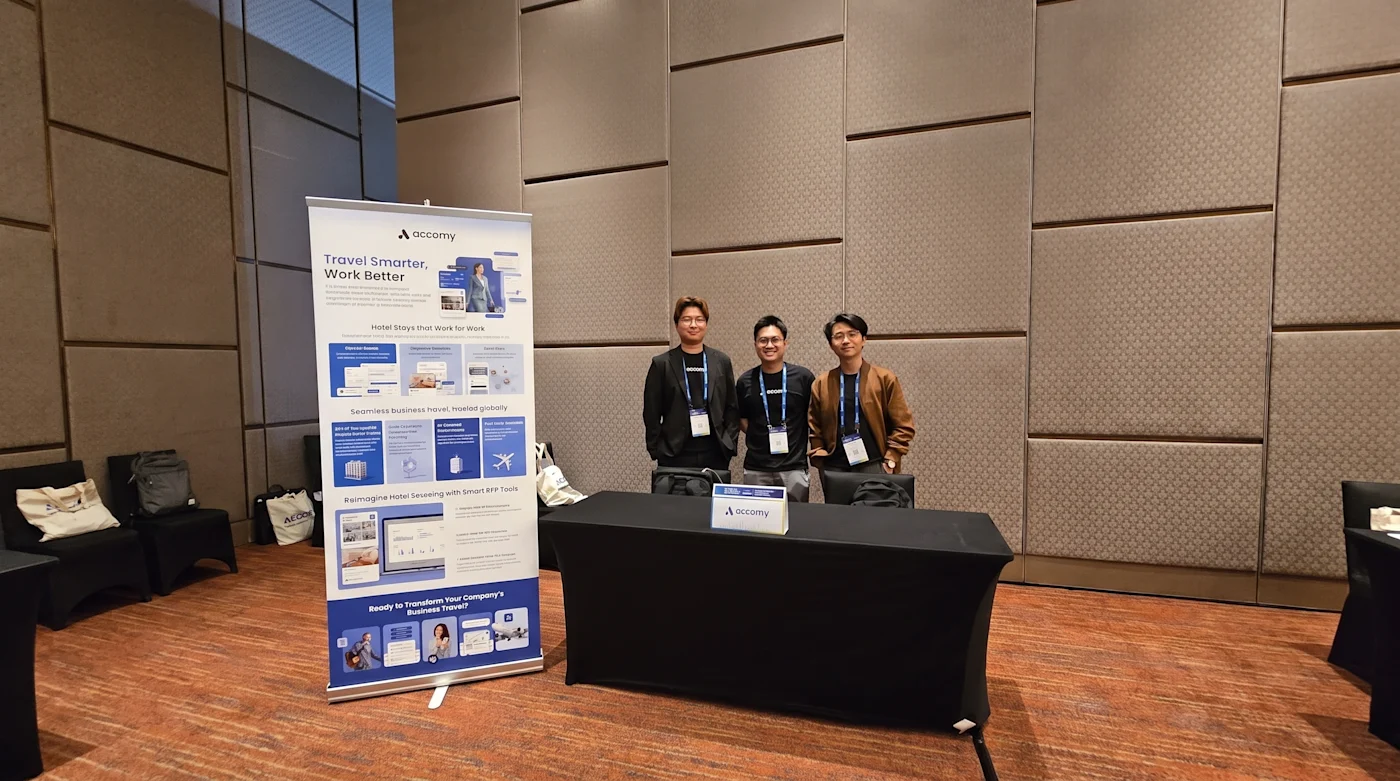
We booked a stand at an AI conference. People wanted to talk about hotel budgets.
The first person to stop at our table asked whether we could stop her staff booking hotels above budget.
I had spent the flight reading about sovereign cloud.
World AI Show Malaysia, DoubleTree by Hilton Kuala Lumpur, 9 and 10 September.
I did the reading
The programme was serious. Sovereign cloud and data foundations. Enterprise AI at scale. AI in government and GLCs. Security, governance, trust. Trescon ran it under "Where Malaysia's AI Decisions Get Made", with about 50 speakers and 500-odd pre-qualified delegates, MDEC and MIDA attached as strategic partners. It was the 48th edition they've run globally.
So that's what I prepared for. I went deep on our own AI products. I read everything I could find on where AI booking actually falls over, what travellers complain about when a machine plans their trip, why people distrust AI products in general. If anyone wanted to argue about whether any of it works, I was ready.
Over two days, one person asked me about AI.
Four of us went. Me, Jiunn Thong from business development, Timothy Chow who looks after global customers, Jasmine Ho from marketing. By lunch on day one I'd stopped reaching for any of the prep.
The five questions
By the second morning I could more or less call them in order.
"How does this improve our booking process?" Nearly always first, and nearly always from someone who already knew exactly what was broken. Bookings on three or four different consumer sites. Receipts arriving by WhatsApp. Someone in finance rebuilding last month out of card statements.
Our answer isn't clever. It's consolidation. Flights and hotels in one place, policy applied when you book rather than audited afterwards, payment in the right currency, a human you can reach when a trip falls apart. Most of the saving is the rebuilding that stops happening.
"Can you actually stop people booking over budget?" Yes, and the word enforce gets thrown around loosely in this category so it's worth being precise. Caps sit on the traveller's grade and apply at the moment of booking. If the cap is RM 450, a RM 700 room isn't offered as bookable. No variance report next month, no awkward conversation. The control lands where the decision gets made, which is the only place it changes anything.
If someone needs more than spend control at booking, a longer approval chain before anything can be reserved, that's a conversation about their process rather than a feature I can point at.
"Different caps for different grades?" Live, and the same mechanism seen from the admin side. You set the grades, you set the cap for each, the cap follows the traveller into the booking.
This one came up so often, and in such specific detail, that I stopped treating it as a nice-to-have. Several people described the identical workaround. A policy document nobody reads, and a manager who occasionally notices.
"Why not just use Trip.com or Booking.com?" The fairest question I got, and the one where I could hear myself failing in real time.
I'd start with where our supply comes from. GDS. NDC. Direct contracts. And then I'd watch it land on someone who had come to talk about cloud infrastructure and had no earthly reason to know what a GDS is. So I'd compensate by listing features, which is worse.
Those are our words, not theirs. At an AI conference, the jargon that lost people was mine.
Here's the version I should have been using. Most travel platforms can only show you what one source gives them. We pull from four: the reservation systems travel agents have used for decades, the feeds airlines now run themselves, contracts we sign directly with hotels and airlines, and other booking sites on top. Four sources means a wider set to choose from, and you're less likely to miss the room that was never shown to you.
Your own negotiated rates sit alongside the public ones, which a consumer site can't show you because it doesn't know you have any. And we'll run hotel negotiation with you through AgreeEase, with you rather than for you, because the leverage is your volume and your stay data.
Accomy reports hotel savings of 10 to 40% a trip against direct consumer booking. That's our own number, not an audited one.
The bit that never shows up in a price comparison is 11pm on a Tuesday when the flight is cancelled. A consumer platform gives you a help centre.
"So what does your AI actually do?" One AI question. At an AI conference. It was the rarest of the five, and it usually arrived with a bit of an edge, which seemed fair to me.
Her name is Lana. You write what you need in ordinary language and she goes and finds it. Book a flight from KUL to NRT in October 2026, one passenger, and back come airlines sorted by price. Or something messier, two nights in Sapporo from the 13th then three in Otaru from the 15th, and back come hotels around each of those places, for those dates, without you rebuilding the search twice. She searches and suggests. You decide.
So was the room behind on AI?
That's the obvious read and I don't buy it.
The conference agenda was a two-to-three-year agenda. Where sovereign data lives, how enterprise AI survives contact with scale, what governance looks like when systems start acting on their own. All real, all coming. The questions at our table were this quarter's agenda. My staff are overspending on hotels, my policy is a PDF, I can't tell if I'm getting a fair rate.
Both are true at the same time. Most companies don't get to pick which one arrives first.
And the governance questions are coming. Malaysia has a National AI Office now, MDEC and MIDA were strategic partners to this event, so expectations are being set centrally. Centrally-set expectations travel downward. Government and GLC procurement first, then the people selling into them, then everyone sitting in those supply chains.
Which is the useful part, if you're reading this and quietly relieved that nobody in your company has asked about AI governance yet. Sort the operational layer this year, while it's still your choice, and you'll be able to answer the governance questions when they show up on a vendor form. Leave it, and you'll be answering both at once, on someone else's deadline.
Four questions I'd ask a vendor now
Not the conference's questions. If you're choosing a travel platform this quarter, these are the four I'd put to anyone selling you one. Us included.
"What actually reduces my workload?" Note actually. Anyone can answer "what features do you have" because that's a list and lists are easy. This version makes them talk about your process. The good sign is a vendor who asks you questions back. Who books today, what happens to the receipts, who chases approvals. A module list with no questions means you're being sold to.
"Where does your supply come from?" One source or several? Agents' reservation systems, airlines direct, hotel contracts you signed yourselves, other booking sites? This decides what you can see at all, and almost nobody asks it. Single-source isn't automatically bad. You just want to know, because you'll never notice the fare you were never shown.
"Where is your support team, and who's on it at 11pm?" Ask the location, the hours, the language, and whether it's the same team at 11pm as at 11am. "24/7" is not an answer yet. This sounds soft right up until a flight is cancelled and the answer turns out to be a web form.
"How will you help us beyond the software?" Deliberately open. You're asking whether anyone will help you negotiate rates, clean up a policy that's currently a PDF, do the unglamorous set-up. Software and support get sold together and delivered very differently.
If a vendor answers all four without flinching, you've learned something. If they can't, you've learned more.
Anyway
I went in ready to defend our AI and spent two days on hotel budgets. I got the topic right and the timing wrong.
Almost nobody starts at governance. You start with a policy that's a PDF, a finance lead rebuilding last month from card statements, and a nagging feeling you're being overcharged. That isn't being behind. It's just the order the work turns up in.
If someone's asking you what your AI position is and you haven't sorted any of that yet, most of the room was in the same place. Start at question one.
Part of our guide to Corporate Travel Management in Malaysia: The 2026 Guide for Growing Companies.
Frequently asked questions
What was World AI Show Malaysia 2026?
An enterprise AI conference run by Trescon at the DoubleTree by Hilton, Kuala Lumpur, on 9 and 10 September 2026, under the line "Where Malaysia's AI Decisions Get Made". Around 50 speakers and roughly 500 pre-qualified decision makers, with MDEC and MIDA as strategic partners. It was the 48th edition Trescon has run globally. Accomy exhibited with a stand.
Can Accomy stop staff booking above budget?
Yes, at the point of booking. Price caps sit on the traveller's grade, so a room above the cap isn't offered as bookable rather than flagged after the fact. Approval chains broader than spend control at booking are a conversation about your specific process.
Can different employee grades have different travel policies?
Yes. You set the grades and the cap for each, and the cap follows the traveller into the booking flow.
How do Accomy's rates differ from Trip.com or Booking.com?
Supply comes from four places rather than one: the reservation systems travel agents use (GDS), airlines' own direct feeds (NDC), contracts signed directly with hotels and airlines, and other booking sites aggregated on top. The set you choose from is wider than a single consumer site. Your company's negotiated rates appear alongside public ones. Accomy reports hotel savings of 10 to 40% a trip against direct consumer booking, which is an Accomy-reported figure rather than an audited one.
What is Lana?
Accomy's AI travel companion. You describe a trip in ordinary language and Lana searches Accomy's inventory and your company's negotiated rates, then returns options for you to choose from. It searches and suggests; it does not book autonomously on your behalf.
Accomy is the AI-native network that powers corporate travel: booking with policy applied at the point of booking, corporate and negotiated rates, live reporting and a 24/7 multilingual human desk, for companies across APAC and Europe.
Want to see how it handles your routes? Talk to us.
Sources (retrieved 2026-09-14)
World AI Show Malaysia 2026, Trescon, event page (dates, venue, positioning line, speaker and delegate counts, MDEC/MIDA as strategic partners) — https://worldaishow.com/malaysia/
Digital News Asia, Malaysia's AI future takes centre stage as World AI Show returns for its 48th global edition — https://www.digitalnewsasia.com/business/malaysias-ai-future-takes-centre-stage-world-ai-show-returns-its-48th-global-edition