
差旅运营
What the Michelin Key Means for Corporate Travel
Michelin's 2025 Key selection recognised 2,457 hotels on design and service, not corporate value. Here's how travel programmes should read the signal.

What the Michelin Key Means for Corporate Travel
A Michelin Key tells you a hotel is extraordinary. It tells a travel manager almost nothing about whether to book it.
That's not a knock on Michelin. It's a category mismatch. In 2025, the MICHELIN Guide's first single global Key selection recognised 2,457 hotels on design, service, and personality (Michelin, The MICHELIN Guide Sets a New Global Standard for Hotel, September 2025). None of its five criteria measures the things a corporate travel programme runs on. This piece is for APAC travel managers and finance leads who'll start seeing "Michelin Key" in hotel pitches, and need to read the badge without being led by it.
Key Takeaways
• Michelin's 2025 global selection awarded Keys to 2,457 hotels, but its five criteria cover design, service, and value-for-experience: never corporate-rate value, policy fit, or duty of care (Michelin, 2025).
• In 2025, 43% of employees already paid out of pocket to upgrade beyond policy, and hotel upgrades were among the most common (GBTA, October 2025), so prestige is a personal preference, not a programme goal.
• With global business travel spend at a record $1.57 trillion in 2025 (GBTA, 2025), the corporate lever is rate discipline and compliance, not accolades.
• Read the Key as one input after a hotel clears your policy, never as the reason to book it.
What does the Michelin Key actually rate?
In 2024, Michelin extended its logic from restaurants to hotels, launching the MICHELIN Key across 15 destinations, then consolidating it into a single global standard in 2025 (Michelin, September 2025). Keys are awarded on a one-to-three scale, sitting on top of the hotel selection Michelin has curated since it acquired the booking platform Tablet Hotels in December 2018 (Skift, December 2018).
The criteria are the tell. A Key is judged on five things: whether the hotel is "an open door to the destination", excellence in interior design and architecture, consistency of service and comfort, consistency between the experience and the price paid, and individuality: personality and authenticity (Michelin, September 2025).
Read that list through a corporate lens. Four of the five criteria are about experience and expression. The one that touches price asks whether the stay feels worth it, not whether it fits a nightly cap or uses a negotiated rate.
Our reading: there is no Key criterion for corporate-rate availability, RFP participation, loyalty-programme integration, or duty of care. The Key is a brilliant answer to a question corporate travel isn't asking.
The Key measures the stay. It doesn't measure the fit.

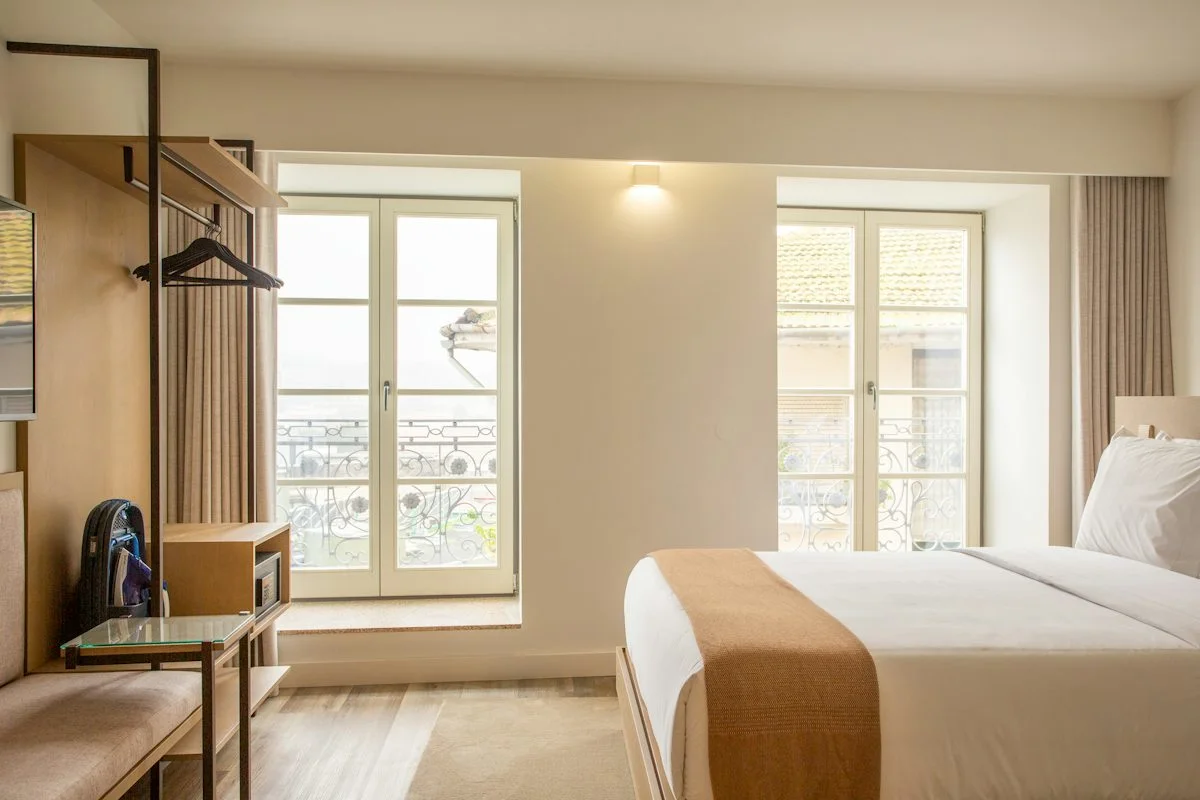
Photo: Musa Ortaç / Pexels
How rare is a Michelin Key, really?
Keys are scarce by design: of the 2,457 hotels in the 2025 global selection, just 143 earned three Keys, 572 earned two, and 1,742 earned one (Michelin, September 2025). The distinction now spans more than 30 countries across six continents, including first-ever Keys in Africa, the Middle East, and Oceania.
Scarcity is exactly why the badge moves booking ehaviour — the restaurant Star proved that for four decades. Expect Keyed properties to lead with it in corporate rate negotiations and RFP responses through 2026.
For a travel manager, that creates quiet pressure. A Keyed hotel arrives pre-framed as the "quality" option, which makes the compliant, well-priced alternative look like a compromise. The badge is doing marketing work, your job is to keep it from doing your sourcing work.
What do corporate bookers actually need?
A business traveller and a leisure guest want different things from the same building, and the data shows travellers already know it. In 2025, 43% of employees said they frequently or occasionally pay the difference to upgrade beyond policy, rising to 50% among travel buyers themselves (GBTA, Business Travel Outlook Poll, October 2025). Among those upgrades, extra hotel nights (29%) and nicer or bigger rooms (26%) were among the most common.
If travellers are already paying for nicer hotels themselves, the programme's job sits elsewhere: on four things the Key doesn't measure.
What corporate travel needs | What it looks like | Does a Michelin Key measure it? |
Rate consistency | The negotiated corporate rate holds across dates and channels | No |
Policy fit | Room type and nightly cap sit inside policy without an exception | No |
Duty of care | Location, safety, and the ability to locate a traveller in a disruption | No |
Reconciliation | A clean folio that maps to the booking and closes the expense | No |
Duty of care isn't a soft concern, either: for blended trips, 59% of buyers rank traveller safety as their top issue, ahead of expense tracking (GBTA, October 2025). A design accolade speaks to none of it. The prestige signal and the procurement signal are different instruments, don't read one off the other.
Where does a Keyed hotel genuinely fit?
There are real cases where a Keyed property is the right corporate booking, and pretending otherwise is how a travel policy loses credibility with the people it governs. The honest answer: it fits when the trip warrants it, not when the badge makes it feel safe.
Client-facing and executive stays, where the hotel is part of how the company presents itself and the premium is a considered decision.
Retention-sensitive travel, where a frequent flyer's experience affects whether they stay in the role, duty of care includes not burning out the people who travel 40 times a year.
Destination-defining trips. An offsite, a board gathering, a milestone, where the setting is genuinely part of the outcome.
The tell is intent. A Keyed hotel booked because a specific trip warrants it is good travel management. A Keyed hotel booked because the badge felt reassuring is budget leakage wearing a nicer logo. Prestige is a legitimate line item: it just isn't a default setting.
How should a travel programme read the signal?
Treat the Key as one input into a standard you already control, not the standard itself. That means writing the four corporate criteria above into your hotel policy, and letting a distinction like a Key influence the shortlist only after a property clears them.
This is where the booking system earns its place. When negotiated rates, policy caps, and approval rules live in one place, a booker sees whether a hotel fits the programme before prestige enters the conversation. The Key can inform the shortlist; the policy still owns the decision.
It also changes what you can measure afterwards. When bookings, rates, and reconciliation live in one system, a travel manager can answer the question most programmes can't: did paying up for the premium property change anything we can measure? That's the question that keeps a hotel line item defensible in a CFO review, rather than leaving it to a spreadsheet at month-end close.
That question matters more in 2026 than in 2025. Global hotel rates are forecast for only modest growth next year, but high-end rates keep climbing, and APAC gateways are the sharpest pressure points: corporate rates in Bengaluru are forecast to rise 6.4%, Hyderabad 5.7%, and Mumbai 5.3% year on year (Amex GBT, Hotel Monitor 2026, via Business Travel News, 2025).
Handled this way, a Michelin Key becomes what it should be: useful context, not a purchasing argument.

What should you tell your team this quarter?
Keep it to one sentence: a Michelin Key describes the stay, not the fit: bookers can note it, but it never replaces the rate, policy, safety, and reconciliation checks.
Then make the compliant path the easy one. If the well-located, correctly-priced hotel is one click away with the corporate rate already loaded, the badge stops being a temptation and becomes a tiebreaker. Most policy leakage isn't defiance. It's friction. Remove the friction and the standard holds itself.
The programmes that handle this well won't ban Keyed hotels. They'll out-organise the badge.
Part of our guide to What Is the Michelin Key? A Traveller's Guide.
Frequently Asked Questions
What is a Michelin Key?
A Michelin Key is a hotel distinction from the MICHELIN Guide, launched in 2024 and awarded on a one-to-three scale to the most remarkable places to stay. In 2025, the first single global selection recognised 2,457 hotels across more than 30 countries (Michelin, September 2025). It mirrors the role the Michelin Star plays for restaurants.
Is a Michelin Key the same as a hotel star rating?
No. Conventional star ratings grade facilities against a fixed checklist. The Michelin Key is a curated distinction weighted toward design, service consistency, destination character, and value-for-experience (Michelin, 2025). A five-star hotel and a three-Key hotel are answering different questions, and neither answers a corporate buyer's.
Should corporate travel policies prefer Michelin Key hotels?
Not by default. The Key measures experience quality, not the four things a programme depends on: rate consistency, policy fit, duty of care, and clean reconciliation. In 2025, 43% of employees already paid out of pocket to upgrade beyond policy (GBTA, October 2025), which tells you prestige is a personal preference, not a programme objective.
When does booking a Keyed hotel make business sense?
When the trip warrants it: client-facing or executive stays, retention-sensitive travel for high-frequency flyers, and destination-defining events such as offsites. The deciding factor is intent: a considered decision for a specific trip, not a default because the badge felt safe.
How do we stop prestige signals from inflating travel spend?
Write your corporate criteria into policy, load negotiated rates and caps into your booking system, and make the compliant option the low-friction one. With global business travel spend at a record $1.57 trillion in 2025 and rising 8.1% forecast for 2026 (GBTA, 2025), rate discipline (not accolades) is where the money is saved.
Why does this matter more for APAC travel programmes in 2026?
Because the region is where corporate hotel rates are climbing fastest. Indian gateways lead the 2026 forecast: Bengaluru +6.4%, Hyderabad +5.7%, Mumbai +5.3% (Amex GBT, via Business Travel News, 2025). When rates are under pressure, paying a prestige premium without a business reason is the easiest overspend to avoid.
Quick Takeaways
The Michelin Key rates design, service, character, and value-for-experience: not policy fit, rate consistency, duty of care, or reconciliation (Michelin, 2025).
Travellers already self-fund prestige: 43% pay to upgrade beyond policy, hotels included (GBTA, October 2025). The programme's job is discipline, not decoration.
With spend at a record $1.57 trillion and APAC rates rising fastest, 2026 rewards rate control over accolades (GBTA; Amex GBT, 2025).
Keep the Key as one input into a policy you own, and out-organise the badge with rates and caps loaded at the point of booking.
Related reading:
How does Accomy work? (the Accomy product explainer)
GDS vs NDC, what's the difference (the distribution-standards explainer)
Sources (retrieved 2026-07-13)
Michelin, The MICHELIN Guide Sets a New Global Standard for Hotel, 10 September 2025 — https://www.michelin.com/en/publications/products-and-services/the-michelin-guide-sets-a-new-global-standard-for-hotel
Michelin North America, 125 Years After Its Creation, The MICHELIN Guide Sets a New Global Standard, 2025 — https://michelinmedia.com/pages/blog/detail/article/c0/a1428/
Skift, Michelin Guide Owner Buys Tablet Hotels to Build a Travel Business, 3 December 2018 — https://skift.com/2018/12/03/michelin-guide-owner-buys-tablet-hotels-to-build-a-travel-business/
GBTA, Global Business Travel Spending to Reach $1.57 Trillion in 2025 (2025 Business Travel Index Outlook), 2025 — https://gbta.org/global-business-travel-spending-to-reach-1-57-trillion-in-2025-amid-trade-policy-uncertainty-and-economic-risk-according-to-new-gbta-forecast/
GBTA, Business Travel Outlook Poll Results, 30 October 2025 — https://gbta.org/wp-content/uploads/GBTA-Business-Travel-Outlook-Poll-Results-publication-October-2025-FINAL.pdf
Deloitte, 2025 Corporate Travel Study (US-only sample), 18 September 2025 — https://www.deloitte.com/us/en/about/press-room/deloitte-announces-corporate-travel-study-2025.html
Business Travel News, Amex GBT: Economic, Geopolitical Uncertainty to Limit 2026 Hotel Rate Hikes (Amex GBT Hotel Monitor 2026), 2025 — https://www.businesstravelnews.com/Lodging/Amex-GBT-Economic-Geopolitical-Uncertainty-to-Limit-2026-Hotel-Rate-Hikes