
差旅运营
Where Locals Eat, Drink & Shop in Bangkok: Business Guide
Eat and shop like a local in Bangkok on business: ~44 Bib Gourmand street eats, institutions, coffee and markets near the CBD — plus how to dodge tourist scams.
Where Locals Eat, Drink & Shop in Bangkok: Business Guide
Bangkok's street food isn't a novelty act. The Michelin Guide awarded roughly 44 Bib Gourmand entries to stalls and small kitchens across Bangkok and its surrounds in its 2026 Thailand selection (Michelin Guide, 2026). On a business trip, the skill isn't finding food. It's eating and shopping where locals actually do, close to where you're working, without losing an afternoon to a tuk-tuk scam. This guide maps that: the anti-trap method first, then street food, sit-down institutions, coffee, markets, and shopping near the Silom-Sathorn and Sukhumvit business districts.
One caveat before you plan around any single place: things change. Hours shift, prices creep, kitchens change hands, and a spot can quietly lose the edge that made it worth the queue. Treat every name here as a starting point, not a guarantee, confirm current status before you build a trip around it.
It's written for the business traveller with a few free evenings and a lunch break, who'd rather eat like a resident than a tourist.
Key Takeaways
• Follow the local queue and turnover: high throughput and mostly Thai customers signal the real thing. A half-empty stall with an English-only picture menu is the tell.
• Bangkok street food is Michelin-serious, around 44 Bib Gourmand entries in the 2026 Thailand selection (Michelin Guide, 2026).
• Both business districts, Silom-Sathorn and Sukhumvit, sit on the BTS/MRT. Use the rail, not taxis, at rush hour.
• Watch for the gem-shop and "it's closed today" scams; use Grab on the meter, and always pay in Thai baht, not your home currency.
How to eat and shop without getting played
Start with a simple filter: follow the local queue and the turnover. Genuine street stalls have high throughput and a crowd that's mostly Thai. A half-empty stall on a tourist strip with an English-only picture menu is the tell. That's the place to walk past, not the one to trust. It's the single most reliable heuristic you have, and it costs nothing.
A few named scams are worth knowing before you arrive. The gem-shop scam, sometimes dressed up as a "government tax-free sale", is the classic: there's no such scheme, so never buy gems on a stranger's or driver's referral. The "it's closed today" trick pairs with it: a friendly stranger says a temple or palace is shut, then offers a tuk-tuk tour that routes through gem and tailor shops. Walk to the official entrance and check the hours yourself.
Two more habits keep you clear. Skip cheap "all-day tour" tuk-tuk quotes, which end at commission shops. And on transport, prefer Grab, the metered ride-hail, over street taxis and tuk-tuks idling at tourist strips: insist on the meter either way.
Finally, two money points. The tourist-bar stretch of Khao San Road is poor value for food; lower your expectations there. And at any card terminal, always choose to be billed in Thai baht, not your home currency, that avoids dynamic currency conversion and its baked-in markup.
Where do locals eat street food?
Bangkok's street food carries real credentials: the Michelin Guide recognises the city's stalls directly, with around 44 Bib Gourmand entries across Bangkok and its surrounds in the 2026 Thailand selection (Michelin Guide, 2026). That's a citation for the whole scene, not one lucky stall. The trick is knowing which names reward a detour and which dishes are better found by turnover than by reputation.
The named stalls worth the queue
A handful of stalls have earned their standing. Raan Jay Fai (Phra Nakhon, Maha Chai Road) has held one Michelin star since 2018, with chef "Jay Fai" cooking her crab omelette and drunken noodles over charcoal. Be honest with yourself first: it's expensive by street-food standards, and in August 2025 it drew a pricing controversy: the shop was fined THB 2,000 after a customer was charged THB 4,000 for a "VVIP" omelette against a listed THB 1,500 (Khaosod English, 2025). It's still operating; just go in with clear eyes.
Elsewhere the value is easier. Jeh O Chula (Pathum Wan, off Banthat Thong) draws a famous late-night local queue near Chulalongkorn University for its tom yum "Mama" instant-noodle hotpot, a Bib Gourmand pick. Go-Ang Kaomunkai Pratunam (the "pink shirt") has served Hainanese chicken rice in Pratunam since 1960 and has held a Bib Gourmand since 2018. And Thipsamai, near Wat Saket, has done its egg-wrapped pad thai since 1966; expect a queue at the original branch.
For two staples, chase turnover rather than a name. Boat noodles (kuay teow reua) are best in the genuine cluster on Boat Noodle Alley, Soi Ratchawithi 18, just north of Victory Monument, where the small bowls run about THB 15-20 (reported, subject to change). For pad kra pao, any busy rice-and-curry (khao gaeng) shop with high turnover will do the job.
[IMAGE: A Buddhist monk walking through a busy covered fresh market in Bangkok, search terms: Bangkok fresh market monk]
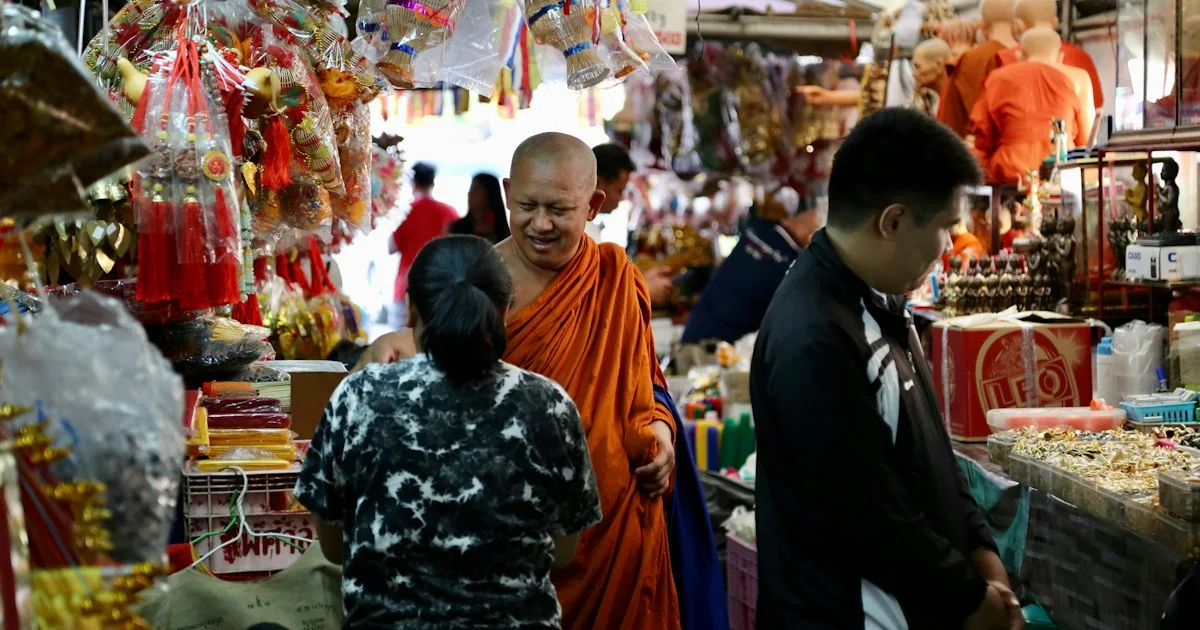
Yaowarat (Chinatown) after dark
Chinatown is its own food destination once the lanes clear around 5pm and peak from roughly 6 to 10pm. Several Yaowarat stalls carry Bib Gourmand recognition (Michelin Guide, 2026): Lim Lao Ngow for fishball noodles from an 80-year-old recipe, Nai Mong Hoi Tod for crispy oyster omelette, and Guay Jub Ouan Pochana for peppery rolled-noodle pork-offal soup. Finish with Pa Tong Go Savoey, doing fried dough with pandan custard since 1968.
Which sit-down institutions are worth booking?
When you want a table and a proper meal, Bangkok's range runs from royal-Thai home cooking to the region's fine-dining frontier. The signal here is stark: in 2024, Sorn became the first Thai restaurant anywhere to hold three Michelin stars (Michelin Guide). That tells you the top end is genuinely world-class, but plenty of the best sit-down food sits comfortably in the mid-range.
Classic and comfort Thai
For central-Thai cooking with lineage, Krua Apsorn (Phra Nakhon and Thonglor branches) has served its stir-fried crab in yellow chilli and crab-meat omelette since 1996, with a royal-Thai pedigree. Methavalai Sorndaeng, by Democracy Monument, has paired classic central-Thai dishes with live music since 1957. For Isaan and eastern-Thai comfort food that suits a group or a business lunch, Supanniga Eating Room (Thonglor, Tha Tien and other branches) is reliably good.
Fine dining and business dinners
At the higher end, Le Du (Sathorn/Silom, near Empire Tower) runs a Michelin-starred modern-Thai tasting menu under chef Thitid "Ton", a strong business-dinner choice. Sorn (Sukhumvit 26) is the southern-Thai three-star; book far ahead. Nahm, in the COMO Metropolitan on Sathorn, is a long-running Michelin-starred contemporary-and-heritage Thai kitchen, led by chef Pim Techamuanvivit since 2018, in a business-friendly hotel setting. Bo.lan (Sukhumvit/Thonglor area), a trailblazer since 2009, closed in 2021 and reopened in September 2024 in a new samrap set-menu format: confirm the booking format when you reserve. For a skyline set menu, Mezzaluna (two Michelin stars, at lebua) and J'AIME by Jean-Michel Lorain (French, at U Sathorn) sit right in the Silom-Sathorn CBD.
Bangkok's coffee scene, from Ari outward
Bangkok has a serious specialty-coffee culture, and its densest cluster is the Ari neighbourhood. These picks come from specialty-coffee guides rather than broad multi-outlet consensus, so treat them as well-regarded rather than definitively ranked. Still, they're a dependable short list for a morning between meetings or a slower weekend crawl.
Nana Coffee Roasters anchors Ari with a garden and slow-bar house that doubles as a benchmark roaster. Roots, an influential homegrown roaster, is easy to reach at The Commons in Thonglor and inside EmQuartier, and it's brunch-friendly. Over in Ekkamai, Kaizen Coffee does Melbourne-style espresso plus brunch, while Hands and Heart, tucked in an Ekkamai back alley and relocated in 2025, keeps a single-origin filter focus. If you only manage one, make it an Ari morning.
Which markets and food streets should you know?
Markets are where Bangkok's food and shopping overlap, and one of them is world-scale: Chatuchak Weekend Market runs roughly 15,000 stalls, making it the world's largest weekend market (Time Out Bangkok). It's a Friday-night and weekend affair covering everything from vintage clothing to street food. For eating specifically, though, a few clusters do the heavy lifting.
Yaowarat (Chinatown) is the headline night street-food strip; the lanes clear around 5pm and peak from about 6 to 10pm. Or Tor Kor Market, by MRT Kamphaeng Phet, is the premium fresh market: clean, full of prepared food and fruit, and ranked by CNN among the world's best fresh markets (CNN, via Bangkok Post). Two walkable food streets round it out: Banthat Thong Road, the student and late-night strip near Chulalongkorn that's home to Jeh O, and Pratunam, which pairs chicken rice with a sprawling garment market.
Where do locals actually shop?
Bangkok's local shopping isn't the luxury malls in the guidebooks. It's markets, community malls, and indie clusters. Chatuchak alone, at around 15,000 stalls, is where residents hunt vintage, homegrown designers, crafts and homeware (Time Out Bangkok). If you've only time for one shopping stop with genuine local character, that's it.
Beyond Chatuchak, the character shifts by neighbourhood. Ari is full of independent boutiques and lifestyle and natural-goods stores, conveniently next to its coffee crawl. The Commons in Thonglor is a community mall of indie shops, local food and drink, and Roots coffee. Siam Square (Pathum Wan) is the locals' trend hub for youth fashion and indie boutiques. And for time-pressed business travellers, the malls locals actually use for dining and brands (EmQuartier, EmSphere and Terminal 21 around Phrom Phong and Asok) cover a lot of ground under air-conditioning.
Eating near the business district
If your days are spent in the CBD, both major business districts keep you close to strong food, and both sit on the rail. In Silom-Sathorn, the CBD proper, business dinners land well at Le Du near Empire Tower and Nahm in the COMO Metropolitan, with Mezzaluna or J'AIME for a skyline set menu. In Sukhumvit (Asok and Phrom Phong), Supanniga Eating Room and elevated Thai street food suit a relaxed client dinner, while EmQuartier and Terminal 21 handle convenient mall dining when the schedule's tight.
One logistics note that saves real time: both CBDs sit on the BTS Skytrain and MRT, so use the rail, not taxis, at rush hour, Bangkok traffic will eat a dinner reservation alive. If you're the one organising the trip, a travel operating system like Accomy keeps the flights, hotels and approvals in one place so the itinerary holds together; the eating and shopping, happily, is on you.
What we'd flag from experience
In Bangkok the tell is turnover. On a work trip, the stalls worth queueing for are the busy ones full of Thai office workers, not the half-empty ones with an English photo menu and someone waving you in. Ride the BTS or MRT to the food rather than sitting in a taxi at rush hour, keep card payments in baht, and treat the tourist-bar strips as atmosphere, not value. For the work-trip logistics, see our guide to a company trip to Bangkok.
Frequently Asked Questions
How do you spot a genuine local street stall in Bangkok?
Follow the queue and the turnover. Genuine stalls move a lot of food fast and draw a mostly Thai crowd. The clearest warning sign is a half-empty stall on a tourist strip with an English-only picture menu. Bangkok's scene is Michelin-credible too, with around 44 Bib Gourmand entries in the 2026 Thailand selection (Michelin Guide, 2026).
What are the common tourist scams to avoid in Bangkok?
Two stand out. The gem-shop scam, sometimes framed as a "government tax-free sale", isn't real, never buy gems on a stranger's or driver's referral. The "it's closed today" trick has someone claim a temple is shut, then offer a tuk-tuk tour through commission shops. Walk to the official entrance, use Grab on the meter, and pay in Thai baht.
Is Bangkok street food worth it on a business trip?
Yes, and it's efficient. The Michelin Guide recognises the city's stalls with around 44 Bib Gourmand entries in its 2026 Thailand selection (Michelin Guide, 2026), so quality is genuine. Choose stalls with high turnover and mostly local customers, eat what's freshly cooked in front of you, and you'll eat extremely well between meetings without much time lost.
Where should you eat near Bangkok's business districts?
In Silom-Sathorn, try Le Du near Empire Tower or Nahm at the COMO Metropolitan for business dinners, with Mezzaluna or J'AIME for a skyline set menu. In Sukhumvit, Supanniga Eating Room suits client dinners and EmQuartier or Terminal 21 cover quick mall meals. Both districts sit on the BTS/MRT, so use the rail at rush hour.
When is the best time to visit Yaowarat (Chinatown)?
Go in the evening. Yaowarat's street-food lanes clear around 5pm and hit their peak from roughly 6 to 10pm, when stalls such as Nai Mong Hoi Tod and Guay Jub Ouan Pochana are in full swing (Michelin Guide, 2026). Arrive hungry, walk the side lanes, and finish with pandan custard from Pa Tong Go Savoey, which has run since 1968.
Quick Takeaways
Trust turnover, not signage: busy stalls with local crowds beat picture-menu stalls on tourist strips every time.
Bangkok street food is Michelin-recognised, around 44 Bib Gourmand entries in the 2026 Thailand selection (Michelin Guide, 2026).
Book the institutions ahead (Sorn especially), and note Bo.lan reopened in 2024 in a new set-menu format.
Ari for coffee and indie shops; Chatuchak for market shopping; Yaowarat, 6-10pm, for Chinatown food.
Both CBDs sit on the BTS/MRT: ride the rail at rush hour, use Grab on the meter, and pay in Thai baht.
About Accomy: Accomy is a travel operating system that unifies bookings, negotiated rates, policy and payment for APAC companies, and provides an online booking tool for travel agencies.
Related reading:
Planning a company trip to Bangkok (the logistics companion to this food-and-shopping guide)
Sources (retrieved 2026-07-13)
Michelin Guide Thailand, 2026 Bib Gourmand selection (~44 entries in Bangkok and surrounds) — https://guide.michelin.com/th/en
Michelin Guide, Yaowarat (Chinatown) street-food stalls and Bangkok / Sukhumvit dining guides — https://guide.michelin.com/th/en/article
Time Out Bangkok, best Thai restaurants, Chatuchak Weekend Market, Or Tor Kor — https://www.timeout.com/bangkok
Bangkok Post / CNN, Or Tor Kor ranked among the world's best fresh markets — https://www.bangkokpost.com
Khaosod English, Raan Jay Fai pricing case and 2026 Bib Gourmand list — https://www.khaosodenglish.com
Bangkok scams reference, gem-shop, "closed today" and tuk-tuk commission scams — general traveller-safety guidance
每一趟商务出行,都能少花一点。
面向亚太差旅团队的每日津贴更新、酒店价格技巧和现成的政策模板。简短好读,每月数封。