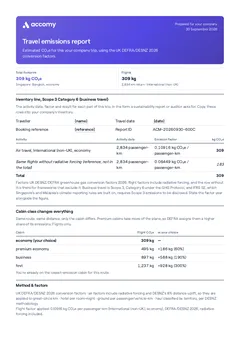
Get a disclosure-ready CO₂e figure for any business trip
Flights, hotel nights and the method behind every number, using the UK DEFRA/DESNZ 2025 conversion factors, the most widely used published factor set internationally. Distance-based, so it applies to any route worldwide.
Your trip
Estimated footprint
309 kg CO₂e
Singapore → Bangkok 2,834 km return
Flights · 2,834 km return · International (non-UK)309 kg
Flights 100%
Economy emits 66% less than business on this route (both DEFRA/DESNZ 2026 factors).
≈ <b>14</b> trees absorbing CO₂ for a year · ≈ <b>1,864</b> km in an average car
Approximate equivalents: ~21.8 kg CO₂/tree-year (USDA); 0.16591 kg CO₂e/km average car (DESNZ 2026).
Ways to cut this footprint
For short legs under ~700 km, rail typically emits a fraction of flying. Direct flights also avoid the extra distance of connections.
📄 Your free emissions report goes deeper
A Scope 3 inventory line: activity data, factor and result, with and without radiative forcing
A cabin-by-cabin comparison and your biggest lever
What to record per trip to total the full year
Prefer to talk first?
How we estimated this
Method: UK DEFRA/DESNZ 2026 conversion factors · air factors include radiative forcing and DESNZ’s 8% distance uplift, so they are applied to great-circle km · hotel per room-night · ground per passenger/vehicle-km · haul classified by territory, per DESNZ methodology.
An estimate for planning and disclosure preparation, not a verified or assured emissions figure. It uses the UK DESNZ conversion factors and your inputs; check it against your own records before reporting. Terms of use.
FAQ
How is business-travel CO2e calculated?
Flight distance (great-circle distance plus an 8% uplift) is multiplied by the UK DEFRA/DESNZ 2025 emission factor for the cabin, with radiative forcing included, then hotel nights and ground transport are added. The full method is shown on every result.
Which emission factors does it use?
The UK Government (DEFRA/DESNZ) 2025 conversion factors, the most widely used published set internationally. The model is distance-based, so it works for any route worldwide.
Does it include radiative forcing?
Yes. Flights include radiative forcing and an 8% great-circle distance uplift, in line with the DESNZ methodology, and this is stated on every result.
How much less does economy emit than business class?
Premium cabins are allocated more of the aircraft's emissions per passenger, so business class can be roughly two to three times economy on the same route. The tool shows the exact split for your route.
How can we cut business-travel emissions?
The biggest levers are flying economy instead of business, taking fewer or combined trips, choosing rail for short legs, and picking direct routes. The tool highlights your single biggest lever.
Is the figure audit-ready?
It is a disclosure-preparation estimate, not an audited figure, but every factor and formula is shown so it can be checked and reproduced.
This trip's emissions report
The full footprint, the levers to cut it, and a format ready for disclosure prep.
Three details unlock your report:
A Scope 3 inventory line: activity data, factor and result
A cabin-by-cabin comparison and your single biggest lever
What to collect to total the full year
Prefer a walkthrough? You can request a specialist callback after your report (optional).
Just these three unlock your report, no phone number needed. We send the figures you entered in the calculator to our team with them, and our team may contact you about your results. Privacy policy.
Trusted across 10 markets · 4.36M+ mapped properties
Tip: in the print window, choose “Save as PDF”.
WhatsAppEmailWhoever opens the link enters their work email to see the report.